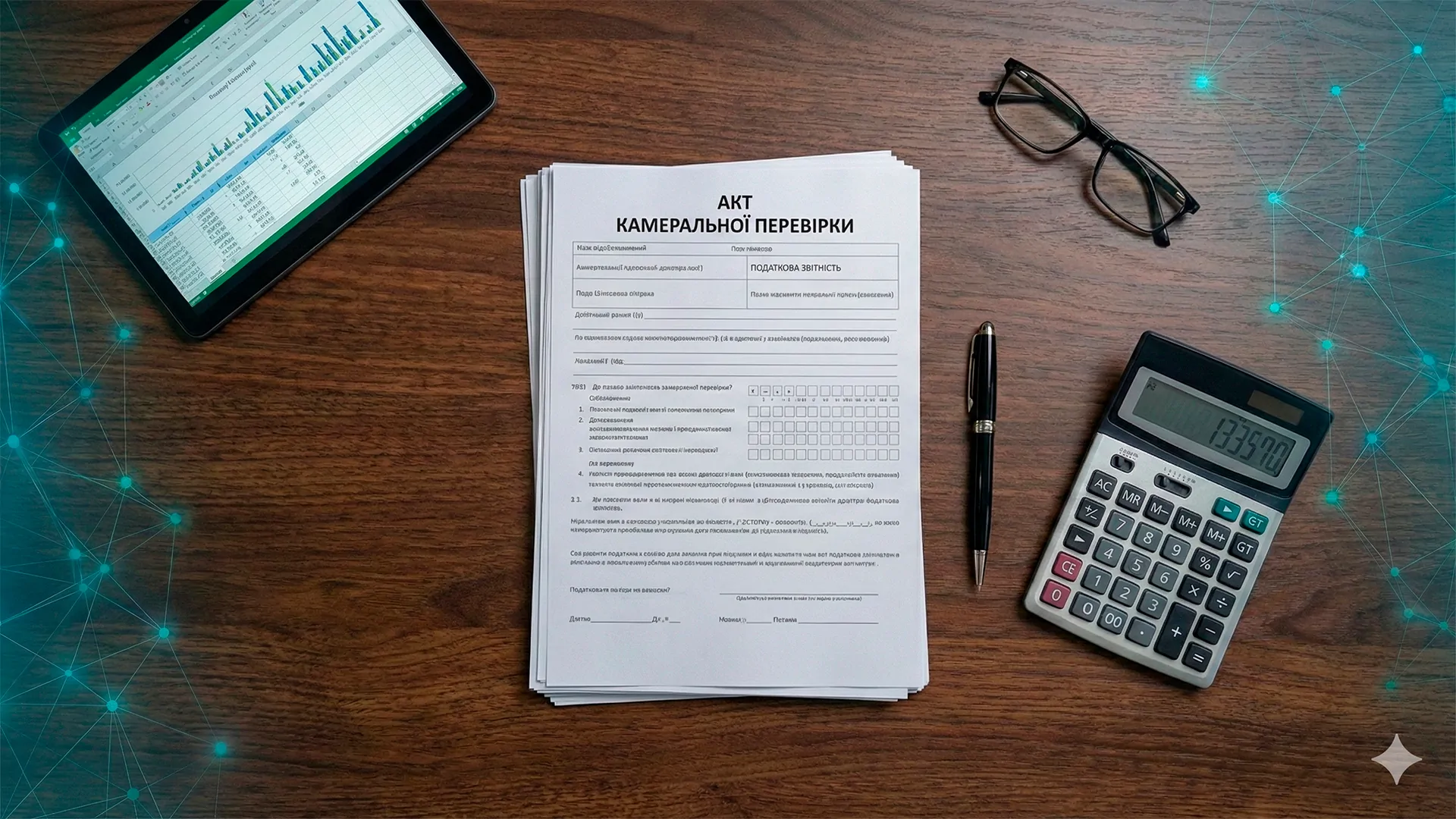
Desk Tax Audit Support
Desk tax audit is the most common type of control by the State Tax Service, conducted for every taxpayer without visiting their place of business. Despite its formal simplicity, a desk audit can lead to serious tax assessments, fines and penalties. Professional legal support at this stage helps protect business from unjustified tax demands and preserve company financial stability.
What is a Desk Tax Audit
A desk tax audit is an audit conducted on the premises of the controlling authority exclusively based on data specified in tax returns and documents submitted by the taxpayer. The legal basis is the Tax Code of Ukraine, particularly Article 76.
Unlike documentary and factual audits, a desk audit does not require a special decision from the tax authority head and is conducted automatically after declaration submission. The taxpayer may not even know their reporting is being audited – notification is sent only if discrepancies or violations are detected.
Desk audit timelines depend on tax type. For VAT declaration – within 30 calendar days, for other tax types – during the reporting period following declaration submission. The tax authority may extend the audit if additional information or explanations are needed.
What Documents Does Tax Authority Analyze During Desk Audit
The main object of desk audit is the tax return and its appendices. Tax service verifies form completion correctness, indicator reliability, data correspondence between different declaration sections.
For VAT verification, analyzed are: tax invoices registered in Unified Electronic Register of Tax Invoices (UERTI), customs declaration data for imported goods, counterparty reporting and their tax history, adjustment calculations to tax invoices.
When checking profit tax, studied are: enterprise financial statements, correspondence between accounting and tax records, justification of expense classification as gross, amortization application correctness.
Tax authorities also actively use external information sources: data from other state bodies (customs, Pension Fund, registration services), information about bank accounts and operations upon request, counterparty information from public registers.
Typical Tax Authority Violations During Desk Audits
Despite process automation, tax authorities often commit violations that may become grounds for audit result appeal.
Demanding documents not provided by law – tax authorities have no right to demand primary documents, contracts, acts during desk audit if they are not declaration appendices. Desk audit is conducted exclusively based on submitted documents.
Exceeding audit timelines without proper extension – if tax authorities failed to complete audit within established deadline and did not decide on extension, such audit results may be appealed.
Assessments without providing explanation right – taxpayer has the right to provide explanations on audit act within 5 working days. If tax authorities issued notice-decision without considering explanations or without providing such right, this is a procedural violation.
Using unreliable counterparty information – tax authorities often make conclusions about transaction fictitiousness based on counterparty data that is outdated or erroneous. Taxpayer has the right to refute such statements documentarily.
VAT Desk Audit: Assessment Risks
VAT declaration verification is most risky for taxpayers, as this is where most disputes and assessments arise.
Main risks are related to tax credit. Tax authorities actively track supply chains and identify counterparties with fictitious signs: absence of real economic activity, mass registration addresses, “technical” directors, lack of sufficient resources for contract execution.
If such counterparty is found in supply chain, tax authorities may refuse tax credit to all subsequent buyers, even if they acted in good faith. Supreme Court has repeatedly stated that taxpayer cannot bear responsibility for counterparty actions if exercising due diligence.
UERTI discrepancies – if tax invoice not registered by supplier in register or registered with errors, buyer may receive refusal of tax credit right. It’s important to promptly identify such situations and demand supplier correction.
Export operations also under close attention. Tax authorities thoroughly verify export fact confirmation, currency receipts, customs declarations and invoices correspondence. Any inaccuracies may lead to VAT refund refusal.
Tax Notice-Decision: How to Appeal
Following desk audit results, tax authorities may issue tax notice-decision on tax liability, penalty sanctions and penalty assessments. This decision is not final and subject to appeal.
Taxpayer has the right to appeal notice-decision administratively or judicially within 10 calendar days from receipt date. Missing this deadline may lead to impossibility of appeal, so it’s important to act immediately.
Administrative appeal is submitted to higher-level controlling authority. This gives time for argument preparation and may lead to decision cancellation or modification without court proceedings. Complaint review period is 20 working days.
Judicial appeal is carried out by filing claim to administrative court. Lawyer prepares statement of claim with detailed justification of notice-decision illegality, collects evidence, formulates legal position.
Effective appeal strategy includes: analysis of procedural violations during audit, appealing assessed amounts calculation methodology, proving economic transaction reality, judicial tax examination appointment, using positive Supreme Court judicial practice.
Lawyer’s Role During Desk Audit
Professional desk audit support significantly increases chances of successful outcome and helps avoid unjustified assessments.
Dextra Law lawyer at audit stage: analyzes submitted declaration for possible tax claims, prepares reasoned explanations for tax authority requests, controls tax service compliance with procedural requirements and deadlines, forms evidence base to confirm indicator legitimacy reflected in declaration.
Upon receiving audit act, lawyer prepares substantiated objections referencing legislation norms and judicial practice, engages independent experts to refute tax conclusions, collects additional documents not considered during audit.
At appeal stage, specialist develops appeal strategy (administrative or judicial), prepares complaint or statement of claim, represents client interests in tax authorities and courts, seeks judicial examination appointment if necessary.
Individual Entrepreneur Desk Audit: Features and Risks
Individual entrepreneurs face specific risks during desk audits, especially those working on general taxation system or VAT payers.
For individual entrepreneurs on general system, tax authorities especially carefully verify expense classification justification as gross. Claims often arise regarding: expenses showing personal consumption signs (housing rent, premium-class cars, food expenses), absence of primary documents or improper execution, expense non-correspondence to declared activity types.
Simplified system individual entrepreneurs also not insured from problems. Tax authorities verify compliance with income volume limitations, number of hired workers, activity type compliance allowed for simplified system. Exceeding limitations leads to transfer to general system with tax assessments.
Special attention paid to individual entrepreneurs working with legal entities on permanent basis. Tax authorities may qualify such relations as employment with corresponding consequences regarding unified social contribution and personal income tax.
LLC Desk Audit: Director and Accountant Liability
Limited liability companies are the most common business form in Ukraine, therefore LLC desk audits conducted especially thoroughly, and stakes much higher due to larger transaction volumes.
Main LLC risks related to VAT operations. Tax service actively uses risk assessment system automatically identifying suspicious operations: work with risky counterparties, purchase and sale volume inconsistency, profitability indicators atypical for industry, transit fund movement schemes.
Transfer pricing also under close attention. If LLC conducts operations with related parties or non-residents, tax authorities verify price correspondence to market level. Deviations may lead to profit tax assessment.
Important to understand responsibility distribution within company. Director bears responsibility for tax accounting organization and reporting timeliness, while chief accountant responsible for calculation correctness and data reliability. Upon violation detection, tax authorities may hold both officials liable.
Lawyer helps delineate responsibility, prove director’s absence of personal intent if errors made by accountant, or vice versa – protect accountant if decisions made by management contrary to recommendations.
Judicial Practice on Desk Audits
Supreme Court decision analysis allows identifying key positions helping taxpayers win disputes with tax service.
Taxpayer good faith principle – Supreme Court repeatedly emphasized that taxpayer cannot bear responsibility for violations committed by counterparties if acting in good faith. Tax authorities must prove precisely taxpayer bad faith, not only chain counterparty problems.
Economic transaction reality – even if counterparty has fictitious signs, taxpayer has tax credit right if proves goods/services receipt reality. Confirmation may be: goods movement (transport documents, warehouse accounting data), service use in own activities, service payment, employee testimonies.
Procedure compliance – courts cancel notice-decisions upon procedural violation detection: audit deadline exceeding, taxpayer explanation right non-provision, unreliable data use without verification, proper conclusion justification absence.
Limitation periods – tax authorities cannot assess taxes for period exceeding 1095 days (3 years), except intentional evasion cases. Tax authorities often try assessing taxes for outdated periods, which is appeal ground.
Why Choose Dextra Law
Dextra Law legal company has significant experience supporting desk tax audits and appealing tax authority decisions. Our specialists deeply understand tax legislation and know how to effectively protect business interests.
Our advantages:
- Tax dispute specialization – we handle dozens of cases monthly and know all nuances
- Preventive approach – we help identify risks before tax claims arise
- Quick response – we understand deadline importance and act promptly
- Comprehensive support – from consultation to Supreme Court representation
- 98% of court cases end in our clients’ favor
If you received tax request, audit act or assessment notice-decision – don’t delay contacting a lawyer. The earlier work begins protecting your interests, the higher success chances. Contact Dextra Law – we will protect your business!
Frequently Asked Questions
No, desk audit is conducted automatically after declaration submission and doesn’t require taxpayer consent. Refusing it is impossible, but one can control the process and appeal illegal tax actions.
For VAT declaration, desk audit is conducted within 30 calendar days from declaration submission date. This period may be extended by tax authority if additional information needed.
No, desk audit is conducted exclusively based on submitted declaration and documents appended to it according to legislation requirements. Primary documents may be requested only during documentary audit.
Missed deadline can be restored through court if valid reasons exist (illness, business trip, etc.). However, better not to miss deadlines and contact lawyer immediately after notice-decision receipt.
Filing administrative complaint automatically suspends notice-decision execution. During judicial appeal, collection may be suspended by court decision on claim security.
Desk audit is conducted regarding current submitted declaration. Past period verification possible only within documentary scheduled or unscheduled audit framework, which has other procedural rules.