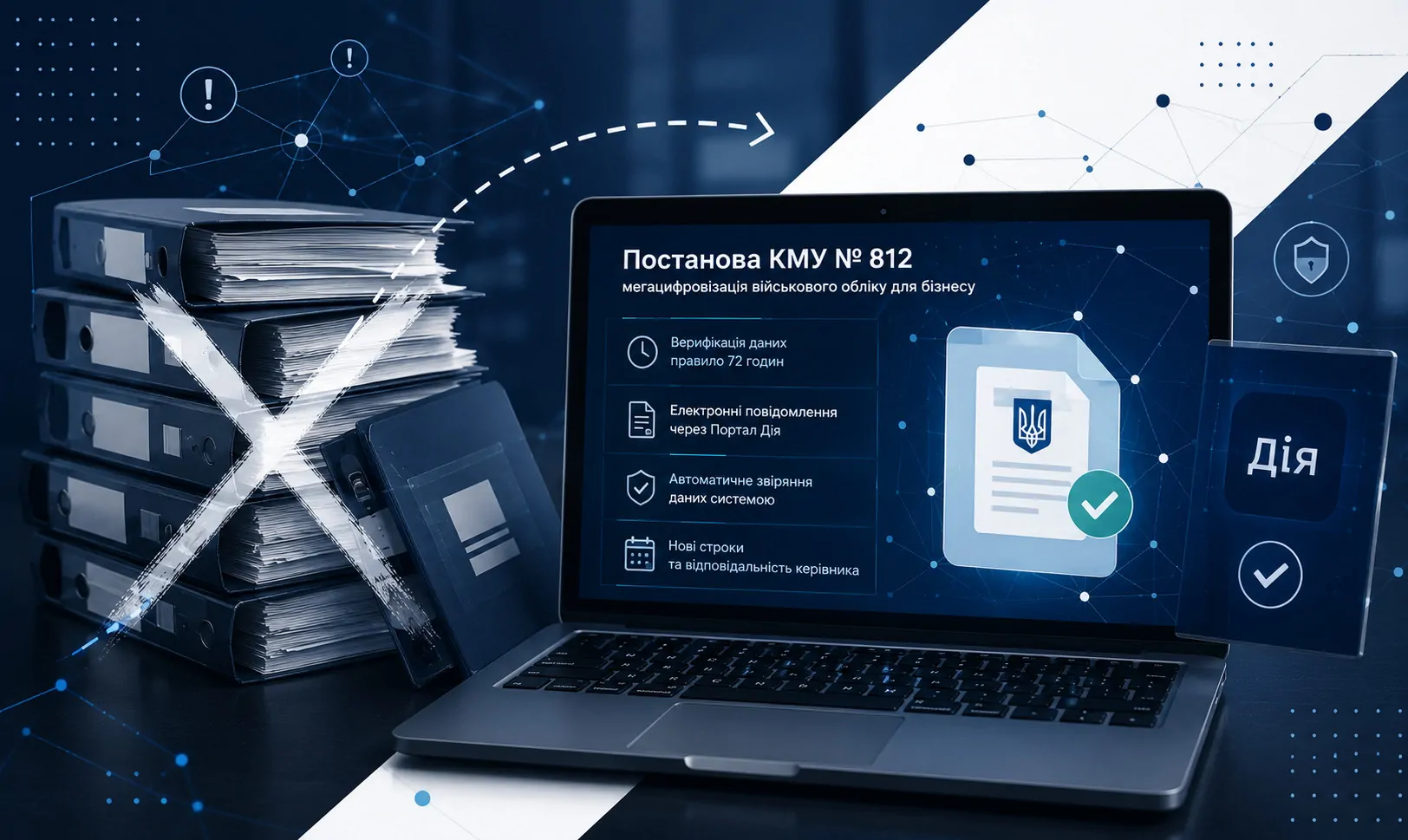
CMU Resolution No. 812: the mega-digitalisation of military accounting for business
The government has adopted Resolution of the Cabinet of Ministers of Ukraine No. 812 of 10 June 2026, which changes the rules for keeping military accounting at enterprises. The main direction is a full move away from paper routine and a shift into Diia. For employers this is not a cosmetic update: it changes the procedure for hiring employees, the format for keeping the Lists and, most importantly, the rules for reconciling data — and the manager is personally responsible for their accuracy and timeliness. The Dextra Law team has analysed the document and put together a practical digest of the main changes that HR directors and those responsible for military accounting need to take into account right now.
Where the reform is heading
Resolution No. 812 amends the Procedure for the Organisation and Maintenance of Military Accounting approved by Resolution of the Cabinet of Ministers of Ukraine No. 1487. The key idea is to move an enterprise’s interaction with the TCC ta SP (territorial recruitment and social support centres) into the digital domain: through the Diia portal, a new State Web Portal of Electronic Public Services in the field of national security and defence, and a new tool — the Electronic Cabinet for keeping personal accounting. The paper format does not disappear entirely but becomes a fallback: where there is a technical capability, everything moves into electronic form signed with a qualified electronic signature (QES).
Key deadlines at a glance
| Action | Deadline |
|---|---|
| Notice of hiring / dismissal (Annex 4) | 7 days |
| Entering changes into the Lists (name, passport, address, position / place of work) | 5 days |
| Monthly notice to the TCC of changes in accounting data | by the 5th of each month |
| Verification of a candidate’s data (the 72-hour rule) | no earlier than 72 hours before hiring |
| Automatic data reconciliation by the system (via Diia) | within 72 hours |
| Data update by the TCC operator (if changes are not confirmed) | within 3 working days |
| “Internal” data reconciliation | at least once a year |
| “External” reconciliation with the employee’s registration TCC | no later than 1 December |
| “External” reconciliation with “your own” TCC | by the end of the year |
Summoning employees: the address has been clarified
Previously, orders summoning employees had to specify the destination “to conscription points (preliminary assembly points)”. The wording has now been clarified: people are summoned directly “to the district (city) TCC ta SP (assembly points)” or “to the place specified in the order”. A small point at first glance, but the templates of internal orders are worth updating to avoid formal discrepancies.
Hiring and enrolment: the “72-hour rule” and verification
This is one of the most tangible changes for HR. When hiring or enrolling for study, the employer is now obliged to check not only the military accounting document itself (paper or electronic) but also the consistency of all the details in it with the data of the Oberih register.
- How and when. The check is carried out against the electronic document from the Diia portal (including via the app) or the new State Web Portal of Electronic Public Services in the field of national security and defence — no earlier than 72 hours before the moment of hiring or enrolment.
- New tool. Where there is a technical capability, verification may be carried out through the Electronic Cabinet for keeping personal accounting.
- The main rule. Official hiring or entry into personal accounting is possible only after the person has registered for military accounting at the TCC ta SP (or with the SBU or an intelligence body).
- Exception. The check of the consistency of paper data with the electronic Oberih register is not carried out in respect of persons liable for military service of the SBU and intelligence bodies.
In practice, this means the hiring process has to be reorganised: verification becomes a separate mandatory stage before onboarding, not after it.
Changes in accounting data
A notice of hiring or dismissal (Annex 4), as before, is submitted within 7 days. Where there is a technical capability, it may be submitted electronically through the Diia portal (under the new procedure of Annex 28-1) or through the personal-accounting cabinet. A key bonus of the digital format: if the notice is submitted electronically, a paper duplicate is no longer required.
If an employee’s name, Ukrainian passport details, declared, registered or actual place of residence, position or place of work have changed, the responsible person enters these changes into the Lists within 5 days. Current changes are notified to the TCC monthly by the 5th — on paper or, where there is a technical capability, via the Diia portal.
For an electronic notice of changes, the responsible person authenticates on the Diia portal using a QES or an advanced electronic signature, and a notice containing sensitive data (name, date of birth, RNOKPP tax number, passport details, address) is signed with a QES together with the head of the enterprise. The system automatically reconciles the data with the registers within 72 hours and generates a notice confirming or rejecting the changes. If the changes are not confirmed, the check and data update are carried out within 3 working days by the TCC ta SP operator.
The updated format for keeping the Lists
The resolution has clarified who is to be kept in the personal military accounting Lists, and for how long:
- Suspended contracts. Employees whose employment contract has been suspended under Article 13 of Law No. 2136-IX must remain in the company’s Lists.
- Dismissed and conscripted. Information on employees who have been dismissed, expelled or released in connection with conscription is kept in the enterprise’s Lists until the end of the current year.
- Column 18. In addition to the date and number of the hiring/dismissal notice, the ground for departure is indicated: “Removed from military accounting by age” (upon reaching the age limit for being in the reserve), “Dismissed from work, studies completed (expelled)”, or “Serviceperson from ‘__’ ______” (release in connection with conscription).
If the military accounting document lacks the information specified in columns 3, 8, 13—16 of the Lists, it is stated in the notice of change of accounting data (Annex 4) and sent to the TCC ta SP.
New data-reconciliation rules
Arguably the most important block of the reform. Reconciliation is divided into “internal” (within the enterprise) and “external” (with the TCC ta SP), and each now has a digital and a paper option.
“Internal” reconciliation
Carried out at least once a year in one of two ways. In the digital option (via the Diia portal, under Annex 28-1), the responsible person authenticates with a QES/advanced signature, generates a request to obtain data and signs it together with the manager, then receives the information from the Register and reconciles it with the Lists. The system automatically checks the data against the Oberih register and the Pension Fund of Ukraine (to confirm employment), and information on the place of work is updated automatically within 72 hours. In the paper option, reconciliation is carried out against the military accounting documents valid as at the date of reconciliation.
“External” reconciliation
Carried out according to a schedule, and if the enterprise is not in the schedule — by agreement with the R(M)TCC ta SP. Here it is important to distinguish two subjects: “your own” TCC (at the enterprise’s registered address) and the registration TCC of each of your employees. Reconciliation with the employee’s registration TCC is carried out no later than 1 December of the current year, and with “your own” TCC by the end of the year, since it takes into account the results of reconciliation with the employees’ registration TCCs.
In the digital option, the enterprise receives a control list, checks it against the actual list of employees, submits a notice of changes if necessary, and then generates and signs with a QES a notice of the reconciliation — once signed, it is locked for editing, which confirms completion. In the paper option, reconciliation is done by registered letter with an inventory of the enclosure and a delivery receipt in two copies; the result is an extract from the lists with an official seal reading “reconciled”, which is entered into the log of inspection results.
Two practical caveats: for persons liable for military service of the SBU and intelligence, electronic reconciliation does not apply — only by post; and the number of reconciliation requests may be limited if an excessive or unjustified number of them is detected.
Why this is critical for reservation (bronriuvannia) and critically important enterprise status
Reconciliation is not bureaucracy for its own sake. The incorrect display of information about employees in the register of persons liable for military service directly distorts the calculation of the reservation quota, and it is precisely internal reconciliation that becomes the tool that allows this to be corrected in good time. For a business that retains staff through the reservation of persons liable for military service, the cleanliness of the military accounting data directly affects the number of employees it will be able to reserve.
This is especially sensitive for enterprises operating under the new reservation rules (CMU Resolution No. 692) or applying for critically important enterprise status. An error in the data here is not only a risk of remarks from the TCC, but also potentially a smaller quota and problems confirming the status.
Personal liability of the manager
Annex 28-1 establishes the direct liability of managers for the completeness, accuracy and timeliness of the data submitted. For submitting inaccurate information, the persons responsible for keeping military accounting bear liability under the law. In other words, digitalisation does not remove liability but makes it more targeted: signing with a QES together with the manager records exactly who is responsible for each notice.
Checklist: what a business should do now
In light of the changes, Dextra Law recommends reviewing and updating:
- the list of duties of the person responsible for keeping military accounting, in light of the new conditions and procedure;
- the availability of a QES for the responsible person to interact with the Diia portal;
- the forms of the personal military accounting Lists of employees;
- the tasks for 2026 (paragraph 72 of Resolution No. 1487);
- the schedule and procedure for carrying out “internal” data reconciliation (paragraphs 34, 45 of Resolution No. 1487);
- the list of TCC ta SP with which reconciliation has already been carried out, and with which it has not yet.
Separately, it is worth keeping not only the general personal military accounting Lists but also extracts from them for each registration TCC of your employees — these are exactly what will be needed for “external” reconciliation.
An important nuance
Part of the digital functionality is still being technically finalised and is gradually being rolled out on the Diia portal. So in the near term, enterprises will operate in a “hybrid” mode — where electronic tools are already available, and on paper where they are not yet. We are monitoring the rollout and will test the new features in practice in order to share real-world use cases.
How Dextra Law helps
Our team supports enterprises in the transition to the updated military accounting rules: we analyse the current state of accounting and documents, update the forms of the Lists and internal regulations, build the candidate-verification procedure under the “72-hour rule”, set up digital and paper reconciliation of data with the TCC ta SP, and synchronise all of this with reservation and critically important enterprise status matters.
Frequently asked questions
The changes were introduced by Resolution of the Cabinet of Ministers of Ukraine No. 812 of 10 June 2026, which amended the Procedure for keeping military accounting (Resolution No. 1487).
Before hiring or enrolment, the employer must check the candidate’s military accounting document and the consistency of its data with the Oberih register, using the electronic document from Diia or the new state web portal — no earlier than 72 hours before hiring.
Correct. If the notice of hiring or dismissal (Annex 4) is submitted electronically through the Diia portal under the procedure of Annex 28-1, a paper duplicate is not required.
At least once a year — either digitally via Diia or on paper, against the military accounting documents valid as at the date of reconciliation.
The head of the enterprise bears direct responsibility for the completeness, accuracy and timeliness of the data; key electronic notices are signed with a QES together with them.
No. For persons liable for military service of the SBU and intelligence bodies, electronic reconciliation does not apply, and the Oberih consistency check is not carried out — interaction takes place by post.
No. For persons liable for military service of the SBU and intelligence bodies, electronic reconciliation does not apply, and the Oberih consistency check is not carried out — interaction takes place by post.
Need help with the transition to the new rules?
The Dextra Law team will analyse the state of military accounting at your enterprise, update the documents and procedures for Resolution No. 812, and synchronise them with reservation and critically important enterprise status matters. Contact us to receive a step-by-step action plan for your business.